> ## Documentation Index
> Fetch the complete documentation index at: https://mohai.mintlify.site/llms.txt
> Use this file to discover all available pages before exploring further.
# High Performance RPC
In the pursuit of a high-performance blockchain, it’s not enough to only optimize consensus or block production. The RPC layer is a critical component of the end-to-end user experience because it is the interface between the blockchain and its users. Stable proposes a new RPC-dedicated architecture to overcome the limitations of traditional RPC design.
## Why High-Performance RPC Matters
### The User’s Gateway to the Blockchain
The **Remote Procedure Call (RPC)** interface is the primary way users interact with the blockchain:
* Wallets use RPC to broadcast transactions.
* DApps query state via RPC to render UI with on-chain data, to prepare and simulate transactions, fetch logs and events, etc.
* Explorers, indexers, and bots all rely on RPC for real-time data.
Even if the blockchain can process transactions at lightning speed and produce blocks rapidly, none of it matters if users experience latency and delays due to a slow RPC. In practice, we often find that RPC is the bottleneck in the overall user experience.
Stable’s roadmap toward a high-performance chain explicitly includes **RPC optimization** as a first-class priority.
## The Problem with Traditional RPC Architecture
### Monolithic Design and Resource Contention
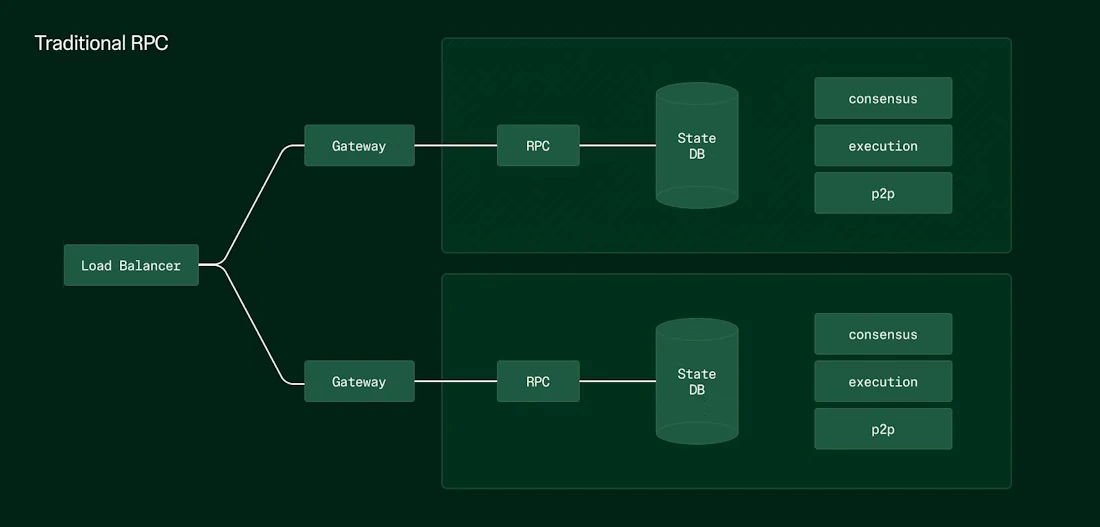 Traditionally, an RPC node is simply a repurposed full node with additional RPC endpoints exposed. This means:
* Syncing the chain and serving RPC requests occur on the same instance.
* To scale RPC, teams must spin up entire new full nodes, triggering resource-heavy operations like state sync and consensus setup.
* Consensus, execution, and RPC all share the same CPU, memory, and disk. For example, during a period of high transaction load, if one component is busy, it **starves the others**, leading to degraded RPC performance.
In addition, traditional RPC architecture treats read-heavy and write-heavy operations in the same architecture. Even though read queries (e.g.,
Traditionally, an RPC node is simply a repurposed full node with additional RPC endpoints exposed. This means:
* Syncing the chain and serving RPC requests occur on the same instance.
* To scale RPC, teams must spin up entire new full nodes, triggering resource-heavy operations like state sync and consensus setup.
* Consensus, execution, and RPC all share the same CPU, memory, and disk. For example, during a period of high transaction load, if one component is busy, it **starves the others**, leading to degraded RPC performance.
In addition, traditional RPC architecture treats read-heavy and write-heavy operations in the same architecture. Even though read queries (e.g., eth\_getBalance) vastly outnumber write transactions, there is no differentiation in how they are handled. This architecture is inherently inefficient and non-scalable.
## The Stable RPC Architecture
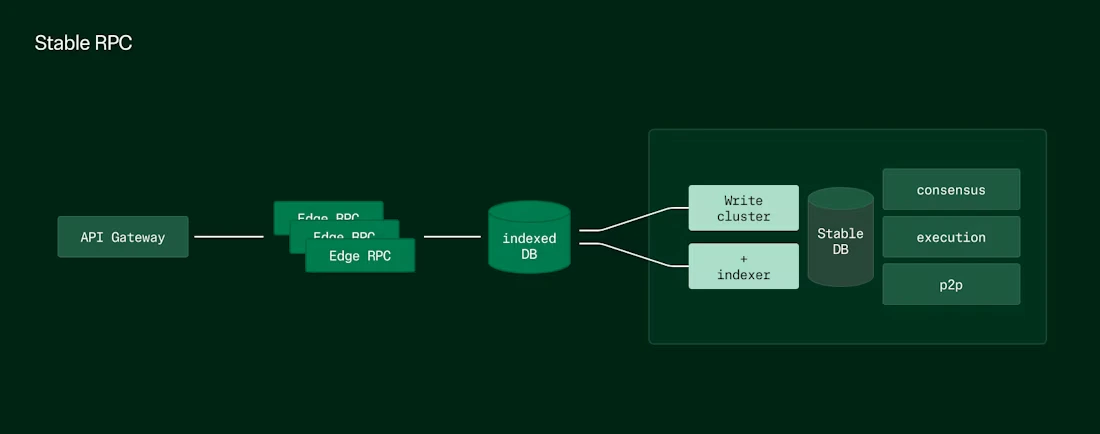
Stable introduces a split-path RPC architecture that separates reads from writes and optimizes each independently.
 ### Core Principles
* Separate the RPC into efficient lightweight RPC nodes based on functionality.
* Use lightweight RPCs as edge nodes to enhance scalability.
* Optimize the data path of function-specific RPCs to reduce latency, offering more direct access or management through more efficient data structures
### Performance Gains
Internal benchmarks of the new read RPC path demonstrate:
* Supports throughput of over 10,000 RPS, with end-to-end latency under 100ms in the same environment.
* Linear scalability of edge nodes, with no need for full state sync or consensus overhead.
Stable’s new RPC architecture results in a significantly smoother and faster user experience, even during high traffic events.
## Future Work
### Optimizing EVM View Calls
One exciting area of ongoing research is dedicated support for EVM view operations (
### Core Principles
* Separate the RPC into efficient lightweight RPC nodes based on functionality.
* Use lightweight RPCs as edge nodes to enhance scalability.
* Optimize the data path of function-specific RPCs to reduce latency, offering more direct access or management through more efficient data structures
### Performance Gains
Internal benchmarks of the new read RPC path demonstrate:
* Supports throughput of over 10,000 RPS, with end-to-end latency under 100ms in the same environment.
* Linear scalability of edge nodes, with no need for full state sync or consensus overhead.
Stable’s new RPC architecture results in a significantly smoother and faster user experience, even during high traffic events.
## Future Work
### Optimizing EVM View Calls
One exciting area of ongoing research is dedicated support for EVM view operations (eth\_call):
* These do not require transaction commitment or state updates.
* Execution can happen on lightweight stateless environments using only the current state snapshot.
* A specialized RPC node could be designed specifically for these operations, delivering even faster response times and reducing load on primary full nodes.
### Integration of Indexer Directly to the Node
By integrating an indexer directly into the node, it becomes possible to serve the fastest possible data to dApps.
* Typical architectures: Node → RPC → Indexer (e.g., The Graph) → Storage → dApp
* Proposed Architecture: Node with Indexer → DB → dApp
* This architecture enables much faster data delivery as the indexer is natively integrated into the node, removing the network communication steps.